Edition #6: Pennie Li
The Path of Elimination
Walk through any UNSW networking event and you'll see the standard pathways: consulting, banking, accounting, tech. Pennie's path was less about choosing the right item and more about figuring out what wasn't on the menu at all.
"The best way I figured this out was really just getting involved in more things including UCC, case comps, clubs, small projects," Pennie reflects. "The more you do, the more opportunities really open up to you."
Entrepreneur Jason Roberts calls it ‘Luck Surface Area’, where the luck you encounter is proportional to the things you do and the people you tell:
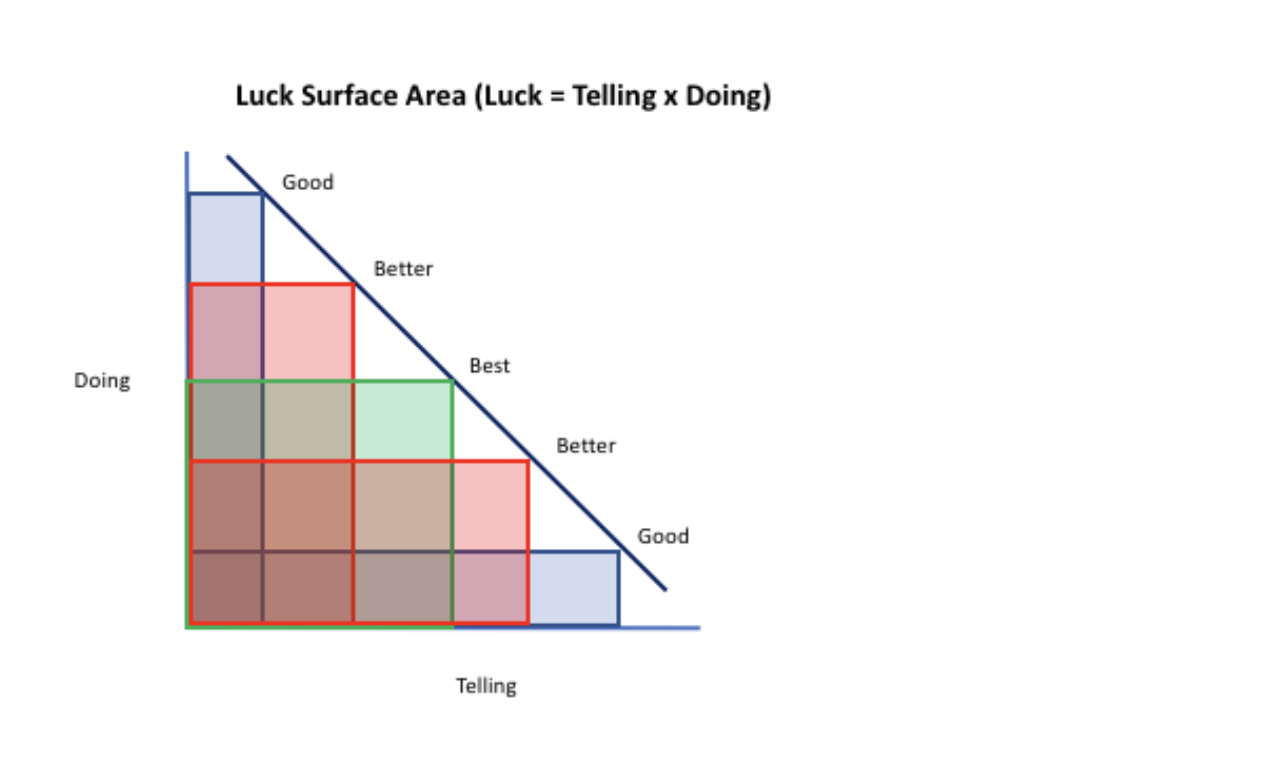
For Pennie, this meant hackathons, side projects and a willingness to let "terrible ideas for the case" turn into 3 AM conversations on "what if we did a startup around that?".
Most of those ideas didn't go anywhere. But each one was a data point. After all, as Pennie says, “the best way to figure things out about a career is by the process of elimination." So it’s not that you need to know if consulting is the path for you. You just need to know enough to say yes, say no, or keep looking.
From Infrastructure to Interface
Pennie and Pasha founded A1 Base during YC. The startup was designed originally as infrastructure for AI agents to operate over SMS, iMessage and other channels. Enterprise clients loved it, but what those clients were building on top caught Pennie's attention.
"A lot of consumer companies building on A1 Base ended up pivoting back to B2B. But the things they were building for consumers had real retention. Day-to-day people were curious about AI and they just didn't have anywhere designed for them."
So they pivoted. A1's app is a platform where campus communities can rapidly build small apps for their specific group. UT Austin built a "rate my rent" tool that went viral on campus. Harvard has its own ecosystem of in-house tools. Each campus generates its own micro-apps, distributed through real social graphs rather than passive feeds.
As for the question of ‘why university campuses’, the answer is simple. University is a formative time when community matters most.
"When you start putting yourself into those circles, you also want to contribute back," Pennie says. "Not just consume the culture, but give back to it."
The Junior-Senior AI Divide
Pennie has been writing code since well before the current AI wave, so when she talks about how building has changed, it's worth listening.
"AI just lets you prototype so much faster. I have an idea, I let it rip, and five minutes later I have a prototype my team can use and give feedback on."
But the fundamentals matter more, not less.
"The difference between junior and senior engineers right now is that juniors just let the AI make decisions. Seniors are a lot better at figuring out what they want to build. They use AI to validate the structure of something, then use it to accelerate implementation."
AI is a force multiplier, but it multiplies whatever judgement you bring to it. For Computer Science students, Pennie says to keep building the foundations. For everyone else, this might be the most accessible moment in history to actually ship something. Pennie also noted that on her recent campus visit, most UNSW students she spoke to, including Computer Science students, still weren't using AI tools in their day-to-day life.
Pennie’s advice is simple - pick a tool, give it a problem and see what happens. That bar shouldn't be a competitive edge in 2026, but right now, it still is.
Permission Denied (And Why That's a Good Thing)
If there's one thing Pennie wanted UNSW students to hear, it's this:
"A lot of Australians have this issue of waiting for permission to do something. You show two friends a small project and think 'maybe I'll wait, who am I to ship this?' Just do it."
She's seen founders aged 18, 19, 20 building entire products in AI, not because they were prodigies, but because everyone is figuring it out as they go.
"While you're young, hungry, and you have the time and the lack of responsibility to just go try it out. Worst case, you fail, but you learn a lot."
Pennie's story isn't remarkable because she took an unconventional path. It's remarkable because she gave herself enough surface area for that path to find her. The principle of ‘do more, tell more, eliminate what's not for you’, works whether you're aiming for MBB, a boutique or something that doesn't have a name yet.
So whether you've got a side project gathering dust or a half-finished case comp deck on your desktop, maybe this is your sign. As Pennie would put it: just do the thing.
This article was written by Andrew Chen, and edited by Siddharth Ramachandran. All experiences and opinions are their own unless otherwise specified, and do not represent the views of the UNSW Consulting Club or any affiliated organisations and sponsors.
